 © valcker / Wikimedia Commons · CC BY 2.0
How helicopter rescue actually works in Nepal
Heli Nepal · · 7 min read
Who dispatches, who pays, and the insurance clause that catches trekkers out every season.
Helicopter evacuation is the reason a lot of people survive altitude sickness in Nepal. It is also the part of a trek most travellers understand least until they need it.
Dispatch happens by phone
Rescue is coordinated by voice: your guide, your lodge, or you calls an operator or an assistance company, and a crew is tasked. Email is the wrong channel — nobody is watching an inbox at 04:00.
If you are travelling independently, carry the operator's number written down, not only in an app that needs signal.
Altitude limits what can be done
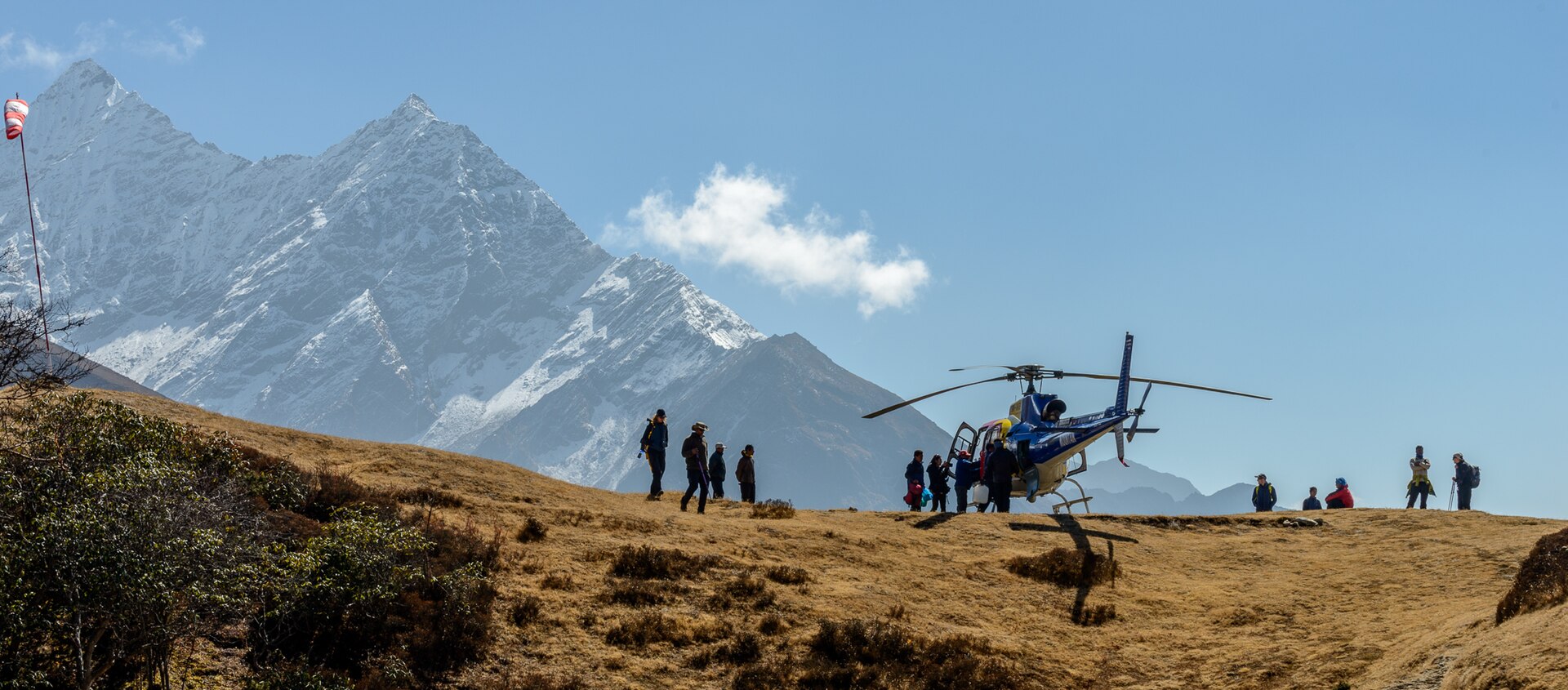
Above roughly 6,000 m, a conventional helicopter cannot land and hover-loading or longline extraction becomes the only option. That requires specific crews and equipment, and not every operator has them.
Descending on foot even a few hundred metres often turns an impossible retrieval into a straightforward one.
The insurance clause that catches people
Many standard travel policies either exclude helicopter evacuation entirely or cap it far below the real cost of a high-altitude retrieval. Some exclude trekking above a stated altitude — frequently 4,000 m, which is below Everest Base Camp.
Read the altitude limit and the evacuation cap before you leave home, and carry proof of cover with you.
Paying for it
The flight happens first and the paperwork follows. Reputable operators will not delay a genuine medical evacuation over billing, but they will pursue the claim afterwards, and if your policy does not cover it the bill lands on you.